You love Tudor history and graphic design - me too!
Pandemic Sleuthing to Re-identify a Tudor Queen (Five year anniversary)
Research by Ashley Risk and Laura Loney
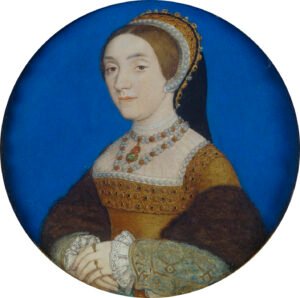
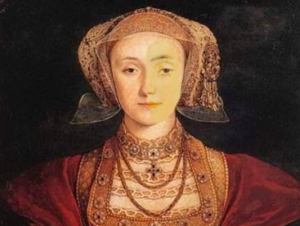
Hans Holbein the Younger – Portrait of a Lady, perhaps Katherine Howard
Covid-19 arrived unwelcome on the world’s doorstep in early 2020. Our own smaller worlds adapted from face-to-face interactions to screen-to-screen. This is how Ashley and I met. Both history aficionados and bad joke tellers, we connected online over our fascination with the Tudor dynasty. Although in two different countries (Ashley lives in the United States and I am in Canada), we became each other’s sounding boards for our buzzing history questions. One such question was, “Do you think this miniature portrait is Katherine Howard?” We both shared the same sentiment, “Not really. It looks too much like Anne of Cleves.”
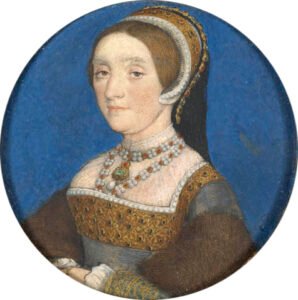
Communicating only through instant messages, Ashley’s texts sounded as real to me as any good friend sharing conversation over coffee. We spent a lot of our quarantine time of 2020 keeping our children entertained and our own minds busy exploring the possibility that the Royal Collection Trust’s portrait (RCT Miniature) labelled Unidentified Sitter, Possibly Katherine Howard by Hans Holbein the Younger (Holbein), is actually Anne of Cleves (Anne). There are two versions of this miniature, but for the purpose of our research we will be discussing the RCT Miniature, which we accept as a Holbein original, and not the Buccleuch Collection.
2. Catherine Howard – by Hans Holbein the Younger, circa 1540, Buccleuch version.
In May, 2021 art historian Franny Moyle’s research on the RCT Miniature made global headlines. Having researched the painting ourselves for a year, this news reassured us our own research was worthwhile.
We are not professional historians, but we each hold university degrees in History and spend our lives enthralled by all things Tudor. We like to call ourselves the History Sleuths. Here are our findings.
Painting Provenance
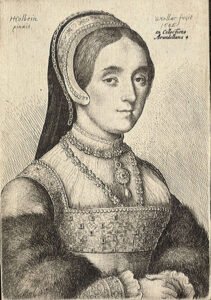
3. Catherine Howard, by Wenceslaus Hollar in 1646
To re-identify the sitter in the RCT Miniature we knew it would be helpful to track the miniature paintings back to Anne. The Buccleuch Collection version was copied by Wenceslaus Hollar in 1646 and then labelled ‘ex Collections Arundelliana’ (1). From this we know that at least the Buccleuch version was owned by Thomas Howard, 14th Earl of Arundel, a prominent art collector.
Anne died on July 16, 1557 with no heirs to inherit her worldly goods. One of the executors named was Henry Earl of Arundel (Henry FitzAlan), and Anne’s will stipulated her remaining items not otherwise bequeathed (including her art collection) would go to the executors to sell, keep or distribute (2). For lack of a paper trail, we can speculate a straightforward trail to the Arundel Collection if Henry FitzAlan kept her miniature portraits.
Upon Henry FitzAlan’s death in 1580, his art collection passed to his son-in-law John, Baron Lumley, a prolific art collector with an interest in subjects of the Tudor court of Henry VIII (3). Lumley died childless in 1609 and his art collection was divided between Lumley Castle and his nephew, Thomas Howard, 14th Earl of Arundel (4).
Likely the first reference to the RCT Miniature is in a 1660-61 Inventory of goods listed as ‘a woman after ye Dresse of Henry ye Eights wife’ (5). There is also no known association between the miniatures and Katherine Howard until the mid-1700s (6). An engraved version of the Buccleuch painting was done by Jacobus Houbraken for Thomas Birch’s 1743 book Heads of Illustrious Persons of Great Britain (7). This book includes illustrations of all six of Henry VIII’s wives. Is it possible the unidentified miniature filled a publishing gap if there were no known images of Katherine Howard available? There is no known evidence to support this claim, but it is thought provoking.
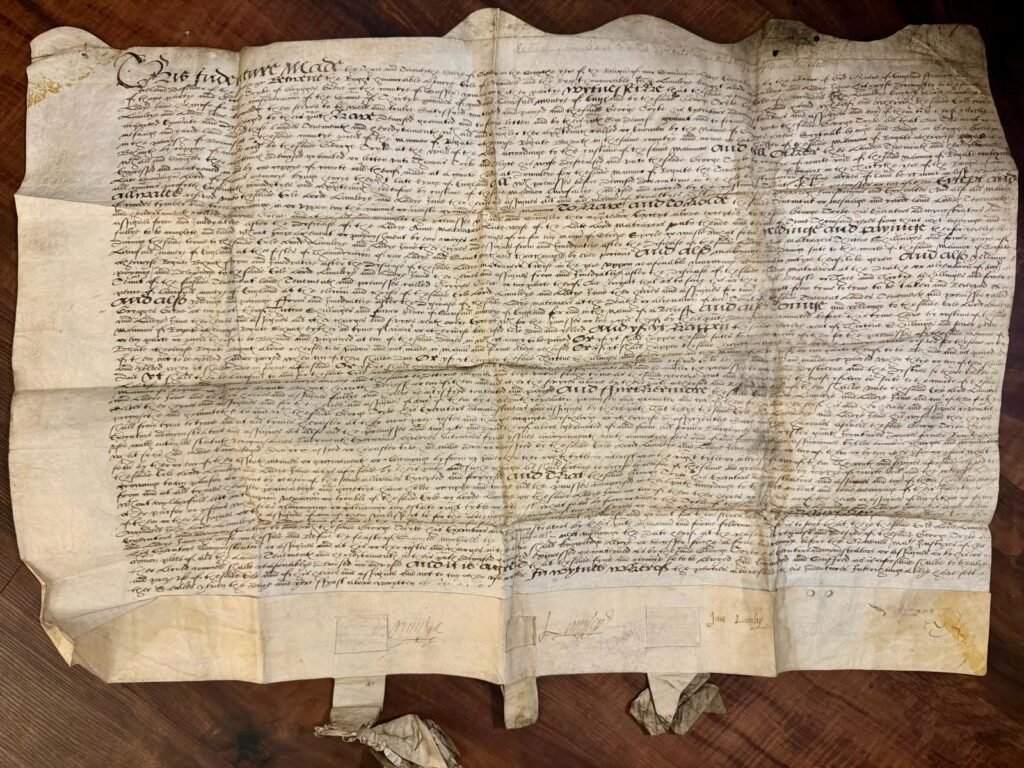
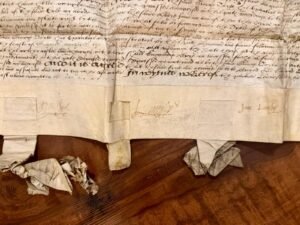
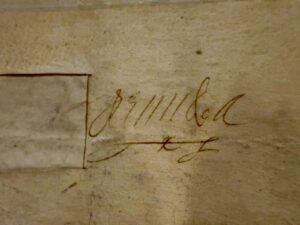
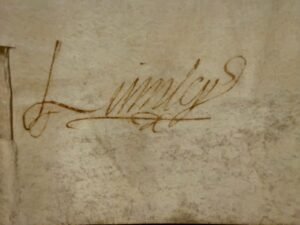
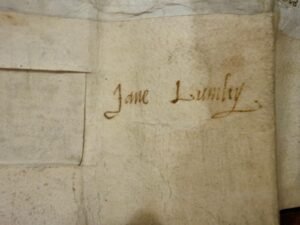
[2026 update: Photos of an indenture signed by the Earl of Arundel (Henry FitzAlan), Lord Lumley, and his wife Jane Lumley. Ashley recently purchased a set of these original documents online and we wanted to included some images to showcase their signatures. We found it particularly interesting to see a woman’s signature included.]
A. An indenture signed by Henry FitzAlan, Lord Lumley, and Jane Lumley.
B. Closer look at the signatures.
C. Signature of the Earl of Arundel (Henry FitzAlan)
D. Signature of Lord LumleyE. Signature of Jane Lumley
.
Hidden Symbols and Imagery
[2026 update: When this article was originally posted in October, 2021, we received some criticism for this section. We were accused of experiencing pareidolia and making things up. Not everyone is always in agreement, but we hold to our belief that while not everything may be a confirmed symbol hidden within the portrait, it is important to consider the idea. Everyone sees things differently and dismissing new ideas without valid consideration and exploration can lead to overlooking what may be valid information. Besides, historical paintings are often rich with symbolism and miniatures could be meaningful, personal gifts. If nothing else, we think it makes for a fascinating read!]
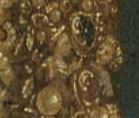
4. Close up of the faces seen in beads of Anne’s headdress.
Many late nights were spent zooming in on aspects of the RCT Miniature and tracing hidden objects while asking, “What do you see?” When responding, “I see that too,” we knew we were onto something. We acknowledge Holbein as an artistic genius, known for his photo-realistic paintings and his ability to disguise symbols within his paintings.
One of the most famous examples of Holbein’s symbolism is in his painting The Ambassadors, 1533, which is riddled with mysterious messages (8). Perhaps less known are the hidden images contained within Holbein’s larger front-facing Portrait of Anne of Cleves, Musée du Louvre (9). A high-resolution image can be zoomed in upon on a screen to reveal miniature faces within the beads on Anne’s headdress. The symbolism contained within these larger paintings gave us hope we would find similar symbols within the RCT Miniature, especially as miniature paintings were originally intended to be viewed with a magnifying glass (10). We were not disappointed.
Symbols, Symbols, Everywhere
What symbols within the RCT Miniature convinced us we were looking at Anne of Cleves?
Necklace
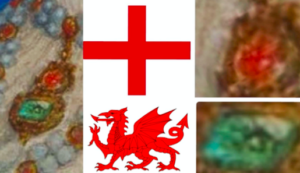
5. Flag of England and Flag of Wales, Wikimedia Commons, edited with Portrait of a Lady, perhaps Katherine Howard (1520-1542.
The sitter’s necklace is also seen in Holbein’s portrait of Jane Seymour, 1536 and has been identified as part of the Queen’s Royal Collection (11). A reigning Queen could wear jewels owned by the Crown, including Anne of Cleves who was Queen consort from January to July 1540.
Zooming in on the necklace pendant, two images appear in the jewels. The top red ruby shows a cross and the green emerald below displays a dragon. The cross resembles the red cross of the Flag of England and the flag of St. George. The dragon likely symbolizes the dragon (often depicted as green) iconically slayed by St. George. St. George and the dragon is tied into Tudor symbolism and a young Henry VIII can be seen in his family painting The Family of Henry VII with St George and the Dragon c. 1503-9, at the Haunted Gallery, Hampton Court (12). The dragon depicted may also allude to the red Welsh dragon shown in Tudor colours of green and white (13). Lady Monteagle is sometimes suggested as a potential sitter for the RCT Miniature based on a vague facial similarity, however this royal symbolism is indicative of a Queen of England, and not a mere courtier (14).
.
Dress sleeves
Symbol 1
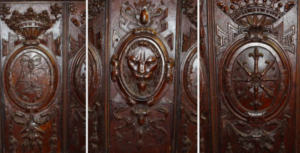
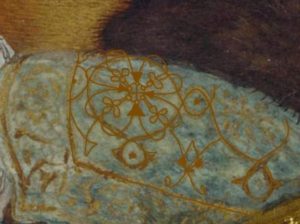
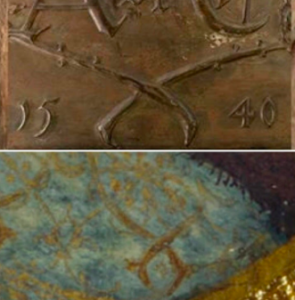
The pattern on the fabric of the left arm of the sitter’s sleeve looks to be an escarbuncle. Anne of Cleves’ family heraldry contains escarbuncles on crests, coins and is a symbol Anne used herself in her personal wood carved panels (15). Was the symbol painted into the fabric by Holbein or was the sitter actually wearing fabric consisting of escarbuncles? Either way, why would Katherine Howard want to wear a symbol so closely associated with her predecessor?
6. Anne of Cleves personal panel. (Photo by Sarah Morris, The Tudor Travel Guide.)
7. Close up of the sitter’s left sleeve. Edited for clarity of the proposed design.
Symbol 2
Underneath Symbol 1, there appears to be two crossed branches. This design can also be seen on Anne’s personal panels (16). The two images are a near identical match.
8. Dress pattern on the sitter’s left sleeve compared to the Anne of Cleves panel design.
.
Neckline
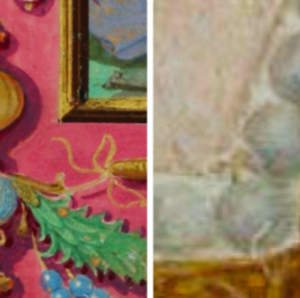
Zoom in, way in, and a tiny tied bow appears in the bottom corner of the sitter’s pearl neckline. This puzzled us for sometime, its meaning unclear. Upon looking through the Prayer book of Anne of Cleves, we found very similar little bows (17). Could this tied bow be a common design element also linked to the more fanciful bowed loops found in Anne’s personal panels?
9. Image in the Prayer book of Anne of Cleves compared to the bow in the pearl neckline of the sitter.
.
Gems
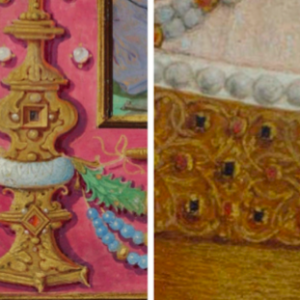
The coloured gems worn by the sitter are predominantly red and black, colours seen in Anne’s family heraldry. They also resemble the gems shown in the Portrait of Anne of Cleves, Musée du Louvre and in the Prayer book of Anne of Cleves.
The red and black jewels along the upper frame of the hood appear different, almost like empty casings, than the pearls directly beside them. There are four coloured gems in the hood that look complete – two red and two black beginning at the sitter’s left side. Did Holbein intentionally only finish four gems for Henry VIII’s fourth wife?
10. Close up of the gems in the sitter’s hood.
11. Comparison of the gems (Left: Anne of Cleves Prayer book; Right: Portrait sitter’s dress).
.
Furs
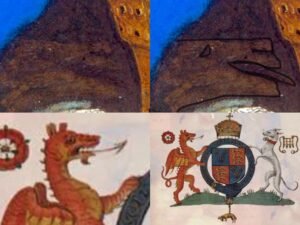
The furs seem to contain intentional shading and symbols too. There is a circular object appearing to be an eye in the fur on the left side of the painting. Using the ‘eye’ as a guide point, a face of a dragon with its tongue protruding, in a right-facing pose, can be squinted at.
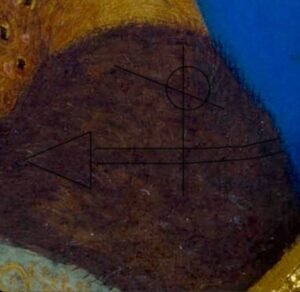
On the right-side of the painting, the sitter’s left fur seems to have shading in the shape of a cross in the top right and possibly a dragon’s tail below. Keeping in mind the necklace’s hidden symbols of a cross and dragon, this could be quite a fitting hidden symbol. The idea that a dragon wraps around the sitter’s fur-clad shoulders strongly suggests she is a Queen as the dragon resembles the Welsh dragon in Henry VII’s coats of arms (18).
12. Dragon face seen in the fur compared to HenryVII’s coat of arms.
13. Dragon tail and cross symbols seen in the fur.
.
.Extras
There are extra oddities we noticed requiring further examination. Above the dragon’s face in the fur is darker shading, not easily identified. Could it be a stylistic ‘A’ that converts to a ‘C’, similar to one found in the Prayer book of Anne of Cleves? There also seems to be a mark in the sitter’s hair, letters or symbols in each pupil, and the embroidery on the cuffs may be more than meets the eye. The sitter’s right cuff falls in a distinctive way resembling a swan. Could this allude to Anne’s family home Schwanenburg, translating to Swan Castle? There are many marks throughout the painting we couldn’t identify and wonder if ciphers or a coded message could be involved.
Symbols Outside of the Painting
The RCT Miniature is painted on vellum (a thin material traditionally prepared from animal skin) and adhered to a playing card – the four of diamonds (19). Was the four of diamonds selected to represent Anne as Henry VIII’s fourth wife? If so, what meaning could the diamonds hold? The escarbuncle found in Cleves’ symbols is representative of a jewel. Perhaps the meaning is as simple as that – wife number four with a jewel symbol.
Playing cards, though, are thought to have carried symbolic meaning. Each suit may hold a unique meaning and the diamond suit might represent the merchant class or nobility class (20). Anne’s brother was William, Duke of Jülich-Cleves-Berg and as Dukes are of the nobility class that could offer one explanation for the diamonds. Anne was also warmly greeted by English merchants at Antwerp in numbers so great “Lord Bure [n] says he never saw so many people gathered in Antwerp at any entry, even the Emperor’s.” (21) If Anne’s marriage to Henry VIII was welcomed by the merchant class, that might offer a second explanation for the diamond card.
The Sitter’s Physical Appearance
Art styles and angles can vastly change the appearance of a person in a portrait. These are paintings, not photographs and something we considered while examining the physical traits of the sitter.
Was Anne of Cleves Blonde?
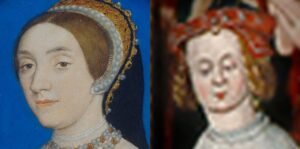
14. RCT Miniature sitter comparison to the Anne of Cleves image in the triptych at St. Lambertus Basilica.
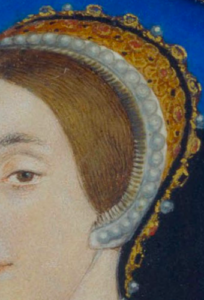
The RCT Miniature shows a sitter with dark eyebrows and reddish-brown hair. Many use the hair colour depicted in the RCT Miniature to rule out Anne as the sitter. This is because an early account by Edward Hall describes Anne on her wedding day saying, “her here hangyng downe, whych was fayre, yelowe and long.” (22)
A triptych painting at St. Lambertus Basilica, in Düsseldorf, Germany displays a young Anne wearing a golden dress and partlet (23). Her hair colour in this painting is a light reddish-brown and is a close match for the RCT Miniature.
So why was she recorded as having fair and yellow hair? We believe Anne may have had fair and yellow hair on her wedding day. The word fair has origins in Old English of the word fæger with a range of meanings including beautiful and attractive (24). So the label “fair” may not have necessarily meant blonde.
What about the yellow reference? Hall may have been referring to the slight natural golden highlights the sitter seems to display. Another explanation may be natural hair dye which has been used for a long time and was even known in ancient Rome. Recipes to not only lighten the hair, but darken it as well, can be read in a translation of a text known as Trotula (25). The text, containing several recipes for dying hair golden and white, centres on women’s medicine and spread through Europe by the 15th century (26). In the 1550s a recipe for dying hair a golden blond was included in a book written by Michel de Nostredame, more commonly known as Nostradamus, for the elite and royals of society (27).
Catherine of Cleves’ Book of Hours, c.1440 contains illustrations depicting The Virgin Mary with long, yellow-golden hair indicating that blonde hair was not only considered beautiful but holy as well –- desirable qualities in a 16th century bride. (28) These widespread sources tell us Anne would have access to and knowledge of these recipes and her royal wedding may have provided the motivation. It is possible Anne had ‘yellow’ hair for her wedding to Henry VIII.
She’s Wearing a French hood
The sitter in the RCT Miniature wears a French-style hood. Many associate Anne with her German-styled fashions as depicted in the famous Portrait of Anne of Cleves, Musée du Louvre. While Anne arrived in England wearing unpopular fashions, she was quick to adapt to English styles at court. An account of Anne wearing a French hood only six days after her marriage to Henry states,“On whiche daie she was appareiled after the Englishe fassio, with a Frenche whode, whiche so set furth her beautie and good visage, that euery creature reioysed to behold her.” (29)
Playing the ‘partlet’
The sitter is wearing a partlet – a light undergarment of sorts concealing a deep neckline. A partlet can be seen in several 16th century German portraits and often has a colourful ring around the neck as seen in the Portrait of Anne of Cleves, Musée du Louvre. There are various styles of partlets and the one the sitter wears closely resembles one seen on Anne in the triptych at St. Lambertus Basilica. So while Anne adapted to English court styles, she may have preserved the modest tradition of covering her neckline as seen in her other portrait depictions.
Rings
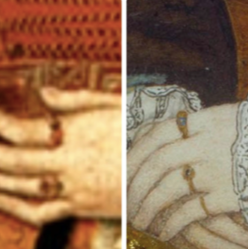
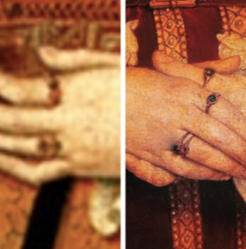
We noticed similarities between the sitter’s rings and those depicted in portraits of Anne. The ring on the sitter’s left pointer finger looks like a gold band topped with two gems set side-by-side, one blue and one orange in colour. In the portrait of Anne of Cleves by Barthel Bruyn the Elder, the sitter wears a similar ring. While it is impossible to know if it is the same ring, we noticed two-gemmed rings are more commonly seen in portraits of individuals originating from Cleves during the mid-16th century and seem to be less frequently seen in English portraits.
Another ring in the Barthel Bruyn the Elder portrait – a double banded gold ring with two gemstones – looks to match a ring worn by Anne in the Portrait of Anne of Cleves, Musée du Louvre. These examples may indicate Anne wore preferred rings in her portraits.
15. Comparison of the rings between the RCT Miniature and the portrait of Anne of Cleves by Barthel Bruyn the Elder.
16. Comparison of the rings between the portrait by Bruyn the Elder and Holbein’s Portrait of Anne of Cleves, Musée du Louvre.
.
Facial Features
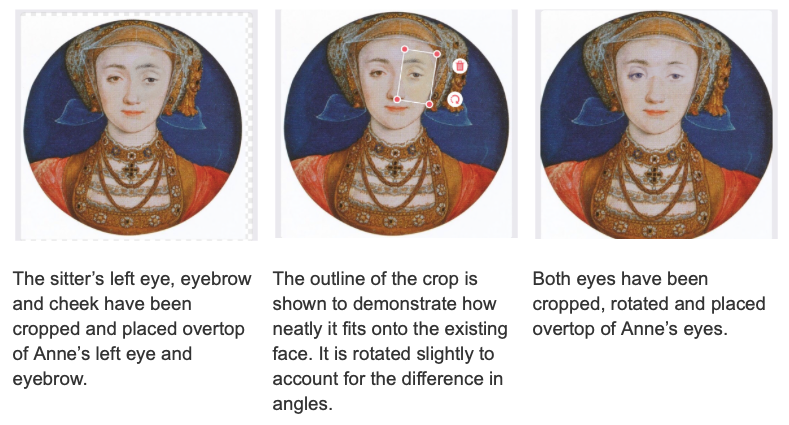
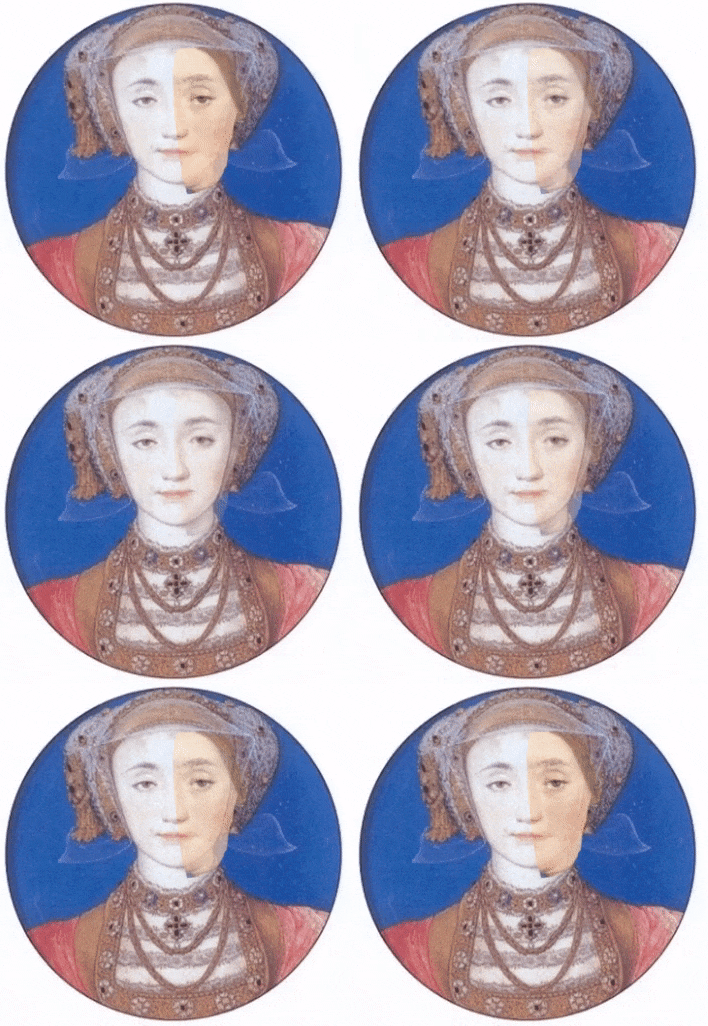
Anne’s portrait and those of her family members including William, Duke of Jülich-Cleves-Berg and her sisters Sibylle and (likely) Amalia of Cleves, share a common facial feature of heavy-lidded eyes. The sitter in the RCT Miniature has similar eyes. Not only that, but the sitter’s nose, mouth, face-shape and slight double chin, closely resemble Anne in her other portraits. To explore these similarities, we conducted a series of graphic design experiments using portrait versions in the public domain.
Graphic design experiment
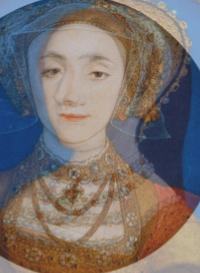
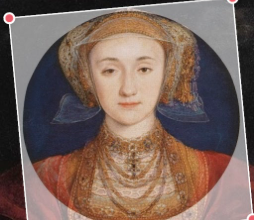
Adjusting the rotation (to account for the difference in the angles of the sitters) and opacities, we experimented with bringing cropped pieces of the public domain copy of the RCT Miniature portrait onto Anne portraits. The result often felt as though we were snapping together a near 500-year-old puzzle. Taking into account these edits were created from paintings done by artists in varying styles and are not photographs, the results feel quite remarkable.
18. The RCT Miniature superimposed image at approximately half-opacity over the front-facing Holbein miniature of Anne of Cleves from the Victoria and Albert Museum.
19. The Anne of Cleves, Victoria and Albert Museum miniature, superimposed over the Portrait of Anne of Cleves, Musée du Louvre, slightly rotated and at approximately half opacity shows it is a near flawless match.
20. The Portrait of Anne of Cleves, Musée du Louvre, with the left side of the RCT Miniature sitter’s face overlaid with full opacity over Anne’s left side. The crop was mildly rotated to account for the difference in angle and the colouring was altered to provide less distraction upon viewing.
21. A rotated crop of the sitter’s left side superimposed on the Victoria and Albert miniature fading in and out.
The Means and Motivation
The RCT Miniature has been dated to 1540, the year Henry VIII was married to both Anne of Cleves and Katherine Howard. Henry VIII’s expense accounts show Holbein, in a salary paid position at court, was paid in advance (30). This means Henry paid to have him on-call to create as requested. Portraits of Anne from 1539 wearing German fashions exist, but in January 1540 she became Queen Consort of England and it makes sense she should be repainted in English fashions.
Henry VIII’s marriage to Anne aligned England with Cleves. In April 1540, an English representative met with Francis I’s sister, Queen Marguerite de Navarre for political reasons (31). During this time, Queen Marguerite requested miniatures of the English royal family including Queen Consort, Anne of Cleves (32).
This information demonstrates that although Anne was only married to Henry VIII for six months, she had both the means and the motivation to have a new miniature of herself created as Queen Consort of England.
Conclusion
We have researched the RCT Miniature to the best of our ability and believe the sitter is Anne of Cleves not Katherine Howard. We are not professionals in the field, but hope the research we provided will be useful to experts in their quest to positively identify the RCT Miniature as Anne of Cleves, fourth wife of Henry VIII.
[2026 Update: Katherine Howard’s likeness]
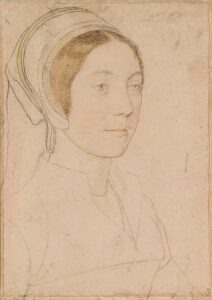
23. Hans Holbein the Younger – Unknown woman formerly known as Catherine Howard
Our research, if correct, sheds light upon the true identity of the portrait sitter as Anne of Cleves, not Katherine Howard. The sting of this statement begs the Tudor enthusiast to cry, “Then what did Katherine Howard look like?” Perhaps, there is an easy remedy to answer that question. Aren’t you happy you stayed until the end of the article?
The much beloved 16th-century sketches by Hans Holbein the Younger include a sketch we believe ‘could’ be Queen Katherine Howard. The appearance of the sketch shares similarities to the miniature discussed in this article, however, as noted by K.T. Parker in his 1945 work, The Drawings of Hans Holbein in the Collection of His Majesty the King at Windsor Castle, the sitter in the sketch does not well enough resemble the sitter in the RCT and Buccleuch miniatures or the portrait in the J.H. Dunn collection (at the National Portrait Gallery), to be labelled as Katherine Howard (33). The latter has been widely accepted in recent years to more likely depict someone in the Cromwell family, such as Elizabeth Cromwell née Seymour, than Katherine. (34). Therefore, her appearance should no longer reflect upon the identity of the sitter in the Holbein sketch. And what if the RCT miniature sitter is Anne of Cleves? What does that mean for the Holbein sketch labelled as “An unidentified woman” but formerly known as Katherine Howard? It seems to us that these primary reasons for this sketch to not be labelled as Katherine Howard are no longer relevant and so, could the face in this sketch be Henry VIII’s fifth wife?
Not only could the sitter be Katherine, but the provenance of the sketch is similar to the RCT miniature. Ownership began with Henry VIII, transferring to Edward VI, Henry FitzAlan, 12th Earl of Arundel, and then Baron John Lumley, and onward. If the RCT miniature can be cited as Katherine with a similar provenance, then there can be no objections, in this regard, to the Holbein sketch, which shares similar origins, potentially showing the true face of Katherine. (35)
This is an interesting topic that we plan to explore further, but what do you think? Could the Holbein sketch illuminate the true face of Queen Katherine Howard? Another history mystery that needs to be solved!
.
Citations
Piper, David (1957). “The 1590 Lumley Inventory: Hilliard, Segar and the Earl of Essex”. Burlington Magazine. 99: 224–31, 299–303.
Strickland, A. & Strickland, E., Parker, C. G., ed. (1867) Lives of the queens of England. From the Norman conquest. New York, Harper & Brothers. [Web.] Retrieved from the Library of Congress, https://lccn.loc.gov/05005826.
Morris, Sarah and Natalie Grueninger, “In the Footsteps of the Six Wives of Henry VIII.” Amberley Publishing, 2016-2017, pp. 220-221.
Hall, Edward (1809). Hall’s chronicle; containing the history of England, during the reign of Henry the Fourth, and the succeeding monarchs, to the end of the reign of Henry the Eighth, ine which are particularly described the manners and customs of those periods. London: Printed for J. Johnson; F. C. and J. Rivington; T. Payne; Wilkie and Robinson; Longman, Hurst, Rees and Orme; Cadell and Davies; and J. Mawman, p. 846.
Green, Monica H. (Editor and translator), “The Trotula: A Medieval Compendium of Women’s Medicine”, University of Pennsylvania Press, 2001, pp. xi-xii.
Goodman, Ruth, “How to be a Tudor”, Viking, 2016, pp. 39-40.
‘Henry VIII: Miscellaneous 1541’, in Letters and Papers, Foreign and Domestic, Henry VIII, Volume 16, 1540-1541, ed. James Gairdner and R H Brodie (London, 1898), pp. 696-730. British History Online http://www.british-history.ac.uk/letters-papers-hen8/vol16/pp696-730 [accessed 8 October 2021].
Darsie, Heather R., “Anna, Duchess of Cleves: The King’s ‘Beloved Sister’”, Amberley Publishing, 2019, pp. 138-139.
Ibid.
Parker, K. T., (1945), Susan Foister (appendix). The drawings of Hans Holbein in the collection of Her Majesty the Queen at Windsor Castle. New York, Johnson Reprint Corp: Harcourt Brace Jovanovich, 1983, pg. 53. [Web.] Retrieved from Internet Archive, https://archive.org/details/bwb_W8-BRU-453, accessed October 2026.
The Anne of Cleves, Victoria and Albert Museum miniature, superimposed over the Portrait of Anne of Cleves, Musée du Louvre, slightly rotated and at approximately half opacity shows it is a near flawless match. (Sources: Anne of Cleves, miniature by Hans Holbein the Younger.jpg, Wikimedia Commons; and AnneCleves.jpg, Wikimedia Commons).
The Portrait of Anne of Cleves, Musée du Louvre, with the left side of the RCT Miniature sitter’s face overlaid with full opacity over Anne’s left side. The crop was mildly rotated to account for the difference in angle and the colouring was altered to provide less distraction upon viewing. (Sources: AnneCleves.jpg, Wikimedia Commons; and Hans Holbein the Younger – Portrait of a Lady, perhaps Katherine Howard (Royal Collection).JPG, Wikimedia Commons).
A. An indenture signed by Henry FitzAlan, Lord Lumley, and Jane Lumley.
B. Closer look at the signatures on the above document.
C. Signature of the Earl of Arundel (Henry Fitzalan)
D. Signature of Lord Lumley
E. Signature of Jane Lumley
Special thanks to Dr. Owen Emmerson who provided early feedback, Natalie Grueninger who hosted the original article on her website On the Tudor Trail, and Claire Ridgway who supported our research through The Tudor Society.
.
Historical sleuthing by:
Ashley Risk is a licensed mental health therapist living in Indiana, USA, who has a lifelong passion for history, sleuthing mysteries and the arts. Ashley has degrees from Purdue University in Psychology, Theatre Arts, and Classical History, as well as a Masters degree from Indiana University. She can usually be found with her husband and daughter, who patiently accompany her to every interesting historical location she can find on the map. You can find her on Instagram, Threads, and Facebook @tudorsreimagined.
Laura Loney is an author living in Ontario, Canada with her husband and two children. Laura holds degrees in History and Semiotics & Communication Theory from the University of Toronto, and a postgraduate degree in corporate communications. She has a life-long passion for history and creative endeavours. Her many interests include graphic design, miniatures, comedy and writing. You can find her on Instagram at @laurelleavesandlaundry and buy her books here.
Article originally published in October, 2021 on On the Tudor Trail website as a guest blog. Updated October 25, 2026.